
Belinda Swan brings front-line insight from NCMEC’s CyberTipline, where reports of sadistic online exploitation (SOE) jumped more than 200%. Unlike traditional sextortion, the goal here isn’t profit or sexual contact—it’s terror. It’s a threat that twists fear into action: hurt yourself, hurt someone else, or we’ll ruin you. We discuss how parents can spot it, stop it, and protect their kids.
Belinda Swan brings front-line insight from NCMEC’s CyberTipline, where reports of sadistic online exploitation (SOE) jumped more than 200%. Unlike traditional sextortion, the goal here isn’t profit or sexual contact—it’s terror. It’s a threat that twists fear into action: hurt yourself, hurt someone else, or we’ll ruin you. We discuss how parents can spot it, stop it, and protect their kids.










Belinda Swan is the Partnerships Program Manager for the National Center for Missing and Exploited Children. Belinda manages NCMEC’s programmatic relationships with government and nonprofit organizations across the country. She also implements NCMEC’s Community Education Partner Program and delivers NCMEC’s child safety programming. Belinda is passionate about bringing communities and organizations together to recognize, address, and prevent safety issues affecting children, especially online exploitation.
Transcription is done by an AI software. While technology is an incredible tool to automate this process, there will be misspellings and typos that might accompany it. Please keep that in mind as you work through it.
SPEAKER_01:
Welcome to the Next Talk Podcast. We are a nonprofit passionate about keeping kids safe online. We’re learning together how to navigate tech, culture, and faith with our kids. I’m joined today by Belinda Swan. She has been here before. She is from the National Center for Missing and Exploited Children. Belinda, thank you for being here again.
SPEAKER_02:
My pleasure, Mandy. Thank you so much for having me.
SPEAKER_01:
Do you want to introduce yourself? Tell us about your role at NickBank.
SPEAKER_02:
Absolutely. So, as you mentioned, my name is Belinda Swan, and I serve as Senior Program Manager for our Outreach and Partnerships team with the National Center for Missing and Exploited Children. While our headquarters is located in Alexandria, Virginia, I’m actually officed in Austin, Texas. So right up the road from San Antonio. And we also have our call center in Florida and another office in upstate New York as well.
SPEAKER_01:
For those of you who think, oh, this name rings a bell, Belinda has been on our show before. We actually did a show on sextortion, what to do if your kid is a victim. They have a really good step process, a resource plan. We talked about the take it down technology that you have. And that is a great resource for if your kid is a victim of sextortion and you don’t know what to do next. So we’ll link that show for you. We we covered it in detail then. Belinda, you’re such a wealth of information and you’re kind of in there with these online dangers and tracking it with kids because you get reports coming in through your website. I wanted to have you back on. What general trends are you seeing now that we need to be aware of as parents?
SPEAKER_02:
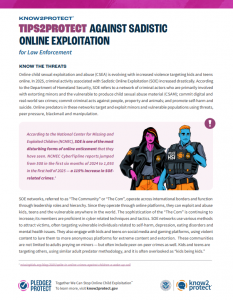
Absolutely. Thank you for mentioning that. You’re exactly right. NickMix serves as the nation’s clearinghouse for reports of exploitation of children, all kinds. Um, in 2024, and just so you know, sometime mid-spring we’ll have an updated report to reflect 2025 data and trends. Uh, but in 2024, we’ve received uh about 20 million cyber tip line reports. The cyber tip line is one of the ways folks can report such instances, suspected and otherwise, to the national center. And what that data tells us, again, as the nation’s clearinghouse of those reports, we’re able to really see in real time the types of trends affecting our children, especially online. So, one of the areas I wanted to focus on with you today, Mandy, and we’ve discussed this in uh in other conversations, is this increase in sadistic online exploitation. Um, and as you mentioned, we discussed sex torsion in our last uh visit. Again, thank you so much for having me. Um, so sadistic online exploitation, again, I I come to every situation as a mom first. So I want to be honest with your listeners. This is a tough topic to process and to and to hear about. So I just want to say to everyone listening or watching, bear with us, uh, stick around. You want to hear how we can work together to keep our kiddos safe. But let’s get a little uncomfortable. I love to share that with folks. We have to get uncomfortable to feel empowered on the other side of these really distressing issues. So, sadistic online exploitation, what is it? How does it differ from sex tortion, which we discussed in our last uh uh podcast? So, with uh other types of sex tortion or online enticement, and as we’ve seen historically, the goal has generally been, you know, let’s be honest here, let’s be real, either sexual contact with a child or uh to collect um CSAM or child sexual abuse images from a child, um, with the rise of financial sex tortion, which is another trend we continue to see. The goal of the perpetrator, as the name suggests, was to gain some sort of monetary uh uh uh uh gain for lack of a better word from the child. But with sadistic online exploitation, the goal, as the name indicates, is is quite evil, honestly. As a mom, that’s the first word that comes to my mind is that these cases are just pure evil. Um, the goal isn’t necessarily sexual contact with the child, but rather to um terrify these children, pardon me, into committing acts of violence on either themselves, others, uh, siblings, and even pets. So in 2024, we actually saw an over 200% increase in reports of sadistic online exploitation to the National Center. Um, when we dive a little deeper, about 69% of those reports were made by uh the public, or specifically in many cases, parents and caregivers. So, what that indicates is potentially a gap between what online platforms are reporting and what parents and caregivers and other members of the public are seeing. And many times in these instances, these reports from parents and caregivers were made after said parent or caregiver indicated a difference in behavior. Sometimes that looks like cutting. Sometimes, unfortunately, that also includes an attempted suicide. Um, and that’s what sadistic online exploitation looks like, unfortunately, in many cases. So, what that means is a potential network of uh of perpetrators work together in many instances of sadistic online exploitation or SOE, as it’s often referred to as well. They will work together to target children, much like other instances of online enticement, sextortion, and so on. They will work together to target children on a variety of platforms. There’s not one particular platform that is more uh that it’s more likely to happen on than in any other, where there’s an online connection and children are gathering, there’s opportunity. Um they will feign a relationship or connection. Sometimes that looks like pretending to have shared interests, or uh if it does happen on a gaming platform, uh pretending to have shared um or needing one another’s help to conquer the next level or to attain particular uh, you know, parts of a game that may be interesting to a child. And once that bond is created, they’ll start to introduce some of these concepts uh similar to sex tortion and other types of enticement, and they’ll start to ask a child to create CSAM or provide images, or they will ask the child to, again, to harm themselves or harm others or harm pets. Now, the threat here, just like with other types of child abuse, can be, you know, once the the images are um are received by the perpetrator, you’ve now created CSAM, you’re gonna go to jail. I’m gonna send these to your parents, your friends, your school. And remember, this is a young child who just a few minutes ago thought perhaps they’d found a new friend to game with online. Uh oftentimes these groups, these organized groups will also purposefully look for spaces online where they can find especially vulnerable children. Uh, think children who are already seeking community or help with an eating disorder or some other sort of vulnerability, and they will seek those children out in particular, uh, feign again that relationship and that friendship, and pressure them into cutting themselves, taking images uh of themselves or video of themselves, uh harming themselves in real time, uh, harming others and so on. And again, the threat is do this or else I’ll find you. I will swat your home, right? Or a false 911 call to send law enforcement and fire to someone’s home. I will share these images far and wide. So I just said a lot, Mandy. I I’m curious to hear if you have any questions or how we can break this down further. And I again, I just want to share with your audience, I know this is hard. Stay with us. So we’ve got some good news too.
SPEAKER_01:
Well, the good thing about the next talk listeners is we’re we’re used to difficult. We’re used to going too hard.
SPEAKER_02:
For better or worse.
SPEAKER_01:
Yeah, yes. And and and you know what? The the hope is that no matter what these predators or this evil out there tries next, we know the solution at Next Talk is the relationship with our kids. So as much as we have to get educated about everything that’s going on, and it’s important to get educated and be aware, we know that fear cannot overtake us, and we we have to spend all our time worrying, putting that into the relationship with our kid, building the conversations, teaching them what to report to us. Yes. Um, you did say a lot. And so, okay, I have some questions. So I think at Next Talk, like we’ve covered sex torsion a lot. As you know, you you even helped us do that. We’ve covered um grooming for online manipulation for nudes, which which you you say the official term C say it again. C SAM, which stands for child sexual abuse material. Okay, child sexual abuse material. I want everybody to understand that’s the that’s the um official term of it that the experts use. As parents, we just say nudes, you know, they manipulated my kid into saying nudes, but I wanted to make that connection for the parent so nobody got lost in that conversation. Um, so we’ve covered those two things extortion and manipulation for nudes and the grooming aspect of that. We cover a lot of the keeping secrets, any little secret. Like even if it’s we’re red today and all we’re red, let’s not tell anybody, because the purpose of that is the predator is trying to create a world where it’s you and your kid against everybody else. Right. So any kind of little secret, red flag, red flag. I think what’s new here for us and our parents is this manipulation to have them go into more of the self-harm, the violence, the hurting others. We have not covered that as much as the other topics. And so if you can go into maybe some red flags that we can look for on that or how to talk to our kids about that, um, because I think this is extremely important when it’s it’s a radicalization. It’s online terrorists trying to come for our kids to radicalize our kids, to hurt others, to hate others. Tell us how we can look for red flags and prevent this and talk proactively with our kids about this.
SPEAKER_02:
Yes, that’s a fantastic question. So, as with other types of, as you mentioned, first and foremost, building a relationship with our children, an ongoing relationship, and and we can talk about some prevention tips in a moment, but some red flags specific to sadistic online exploitation certainly include, now again, I know that this is uh has been an ongoing trend, especially with our teenagers, to wear hoodies, even though it’s Texas and it’s 115 degrees. Um, but uh that’s one thing to look for. A child who otherwise dressed appropriately for the climate or what have you is now suddenly in long sleeves, long pants, refuses to change, uh, won’t roll up their sleeves. What are they hiding? Are they potentially hiding that they’ve participated in some cutting at the request they’ve been exploited by this perpetrator and are trying to hide this desperately? Um another indicator may be there, you know, some cutting behavior in particular patterns or names. We’ve seen instances where perpetrators will demand that the child victim carve names into their body. Um so it’s important that we’re aware of any changes in dress. Um and again, as I mentioned, I’m a mom first and and my mom’s a twin, oh my mom, my child is, it feels like that sometimes. Um my child is a tween, and so we’re we’re struggling over what mom thinks is cute and what she does, but that’s different than a child who refuses to raise a sleeve, uh, refuses to dress as they used to just a few weeks ago. That’s different than finding their voice and their their personal style and fashion choice. Other red flags, of course, are isolation. Um, you know, they they don’t want to come out of their room, they refuse to put down their device, they become really, really agitated when asked to do so. Probably in these instances when a child is being exploited because they’re terrified of what the perpetrator will do if they don’t respond in a timely fashion. Uh again, some of these things are hard and nuanced because many children are going to get upset if you take away their tablet, their phone, or or whatever. But I I think it’s fair to say this would be considerably different. Uh, other things to notice, obviously, are new acts of violence, uh, a different set of behavior in your child that, you know, again, it’s just this trend is going to require so much more of us as parents and as trusted adults to look beyond my kids having a bad day too, and had an outburst to is my child struggling with something much more serious? Did they hit their sibling or the pet, the household, the family pet, because of a of a random outburst in reaction to something bad that happened? Either way, that needs to be addressed as well, or is something deeper going on? And I think that’s what we need to do. That’s the best way to look for these indicators and red flags is recognizing and asking questions and differentiating between your child’s normal or baseline behavior, I should say. What is normal? Um, but your your you know your child’s baseline behavior. How is this different? Um, are there indicators uh from their school behavior? Are they starting to show uh violent tendencies at school? Have are they acting out? Oftentimes, some of these demands of these perpetrators include those random acts of violence, which could happen at school, which could happen anywhere, frankly. So not letting the questions stop there and assume my child is troubled and acting out, period. Are they being exploited and forced to carry out these behaviors? So again, it’s gonna require more of us. We have to dig deeper and have grace for our children and ask more probing questions, um, hopefully before something like this happens. But if if not, we have to just give our children grace and ask more difficult questions. They could be doing this because they feel they have no other choice.
SPEAKER_01:
Well, and I just want to remind parents if if you see any of these sudden behavior changes in your kids, even if you’re doing random phone checks once a week or whatever, if you see behavioral changes, you need to be in the phone more often and you need to be digging deeper to try and see is there a root cause on the phone that we have may have missed or they’re being exploited, or like you said, um forced to do these acts of violence. So I think that’s really good advice. I would also say, and we’ve talked about this before, big big rule for us at next talk is no phones in bedrooms or bathrooms. It’s that isolation piece.
SPEAKER_02:
Sure.
SPEAKER_01:
I know when your kids get older, they may want a game with the door open or certain things like that. You can work with them on that if they’re good kids, but but no phones like at one 1 a.m. in the bedroom. That’s just they’re relaxed, they’re chill. Predators know when to attack our kids. Sure. And so I I I would I just want to say that. Um, I think what you said was very good about the clothing, you know, self-harming marks, violence. You know, if if your kid hits the dog or a sibling and that is that is not normal behavior. Red flag. Like we got to get that kid to a counselor, we got to start digging in the phone or the devices and see what’s going on.
SPEAKER_02:
You know, we have these these baseline expectations with our children when they leave our our home. At school, yes, ma’am, no, ma’am. You will act respectfully toward others and so on. And so there, those are expectations we have for our children. We have to also extend those expectations to their online behavior as well. Um, and sometimes that’s a difficult concept, or it’s it’s because it’s hard, it’s not easy, especially if you’re like myself. Um, you know, my daughter again loves to tell everyone that I was born in the 1900s and she’s not wrong, but it’s so mean, but she’s not wrong. Uh, there is there there will always be a generational divide. And so, although I think I may have covered all the bases and be respectful and make make good decisions, I tell her that every time she leaves the door for school with her daddy, that isn’t enough. We have to sit down with our children and have clear and concise conversations about what red flags look like, healthy relationships, setting healthy boundaries, not only as we expect them to do so in real life, but online as well. We cannot overstress that enough. Those same baseline conversations about expectations and healthy relationships have to be extended to their online behavior as well.
SPEAKER_01:
Well, and I think too, you know, one of the things I’ve always said to my own kids is if anybody is threatening you, if you don’t do this, I’m gonna do this. Just a total red flag to always tell me. You don’t have to handle that alone. I don’t care if you’ve made a mistake. I don’t care if you’ve sent sent something, said something bad. Nobody should threaten you or hold it over your head. So that is a time to get me or a safe trusted adult, you know, somebody, somebody that you I even tell my my kids, and I think this is really important. Like, of course, I want them to come to me, right? But I also help them identify other people in their lives who I know is very trustworthy. Yes, you know, like my like friends or family members, um, youth pastors, you know, coaches, people that you’re like, if you don’t feel comfortable going to be, go to them. Absolutely. But always always reach out for help. You’re not made to carry this stuff alone. No.
SPEAKER_02:
And that’s what perpetrators bank on that the words they use to humiliate our children, to scare our children will do such great harm that they will feel that they have no choice but to carry out what they’re being forced to do. But when we counter that with positive messaging and consistent behavior, just showing up, asking those difficult questions, having those difficult conversations. And again, mom first here, the door is open, the floodgates are open. I hear every single detail. Sometimes mom just wants to sit down and read a book, but hey, you know what? I told her she can tell me anything and everything. So I’ve got to make good on that promise as well. Put the book down, put the phone down, put whatever, and let your children come to you about any and all detail. You’re setting that foundation for when potentially really awful things may happen. Um, we want to make sure they understand that they can come to us and that we’re equipped and prepared to answer with good direction and advice.
SPEAKER_01:
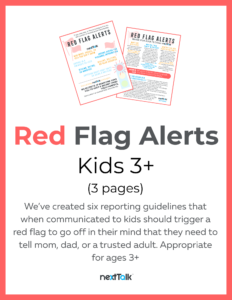
You know, we’re thinking about kids right now with online access. So we’re we’re kind of talking about like mostly older kids that have online access that can be manipulated in this way. But I want to encourage anyone listening, if you’ve got a three, four, or five-year-old, this is why we developed our red flag reporting, right? Because it gets them in the habit of telling you things. And so one of the things on there is any mean, threatening, or bullying language. You and we, you know, we we we say easy language so we don’t overexpose them. But I remember as you’re talking, I remember my son when he started playing Xbox so many years ago, and we he didn’t he couldn’t play online with anybody. It was just, you know, he or his friends he knew in real life. We had that expectation at first. But I remember one time he got completely cussed out by a kid he knew in his class, like like called stupid, you know, the F-word, all the things. And I remember because I had drilled in him if anybody is mean or threatening you or bullying you, you gotta tell me. Right. And so he told me, but he told me in a matter-of-fact way, like it was no big deal. Right. It was like, oh, this person told me stupid and I don’t know how to play this game and da da da. And I stopped for a minute and we we stopped to unpack that because I was like, wait a minute, you’ve got somebody speaking really harmful things into you. That’s not just something to gloss over. How did that make you feel? You know, and I of course I don’t want to make it into a big deal if it’s not a big deal for him, but at the same time, I want to encourage parents of younger kids. You can start this on a smaller scale today, because then when your kids are online playing with people they don’t know, they’re gonna be more prepared because they’ve practiced with you, they’ve brought stuff to you. You you haven’t gone crazy, you’ve, you know, you didn’t rip the Xbox out of the wall, you you kept your composure. Exactly. Yes, and they start trusting you. So this is something that we need to start from the ground up. This is not just a show for 16 year olds that are online. Absolutely.
SPEAKER_02:
Oh gosh, Mandy, I couldn’t agree with you more. And and I’d like to share as a perfect opportunity. We have a ton, the National Center has a ton of free resources specific to that end. So many tips tip. Sheets, videos, games, especially for our kiddos 10 and under, I’ll share with you that we do continue to see reports uh related to children under 10 years old. So this absolutely isn’t an issue of only older kiddos. Where there’s an online connection, where there’s a tablet, where there’s a device, there’s opportunity for perpetrators to access our children. So you couldn’t have said it any better. We have to start having these conversations with children as soon as possible. I like to say if they’re old enough to be on a tablet, they’re old enough to start having a baseline conversation about what’s safe and what isn’t. And again, what our expectations are.
SPEAKER_01:
We know from having older kids, the more you practice this when they’re little, it’s a little bit easier. Even when they get older, when they’re trying to handle stuff on their own, it’s still kind of foundational to talk to your parents.
SPEAKER_02:
Yeah, you want to be that safe place for them to land. And that takes practice and it takes some bumps in the road. But ultimately the goal is to be that safe place. And and Mandy, if I could, just to add to that, part of I think creating that um safe place to land for children, I think also means empowering kiddos. And we touched on this the last time we spoke too. So that means also providing them with tools that they can utilize on their own when they see something. Um, I’ll share with you, I was at a conference, uh, gosh, last month in in Florida was a conference of school resource officers. And after I, you know, we had our presentation, one of the officers uh shared with me an instance, this is another trend, uh, the use of generative artificial intelligence or GAI to create videos, images of one another, right? Children are creating or using this to create uh uh content to humiliate, cyberbully, threaten, extort, sexort one another, right? That’s perpetrators, adults are also using that full stop, uh, but children are also engaging in some of this behavior as well. And so this particular officer shared uh uh an instance where some students used GAI to create an inappropriate video. Um, it wasn’t sexual in nature, but it certainly was inappropriate, of a child and a teacher from their campus. But two brave students, unbeknownst to each other, went to their SRO separately and said, I don’t want anyone to know, but I want you to know, SRO, that these kids made it. It’s not real, and I don’t want our teacher to get in trouble, and I don’t want the student to get in trouble. So I share that antidote to also highlight a separate trend, which is generative artificial intelligence. Again, we have to stay on top of these trends, we have to have these conversations about what’s acceptable, what we expect our children, how we expect our children to behave and conduct themselves in our home and outside of our home and on devices and so on. Oftentimes what we hear is children will make the assumption that it’s not real, so there’s no real harm, and that can’t be further from the truth. The harm is real, uh, the devastation is is just as real. Um the the effects of the bullying are just as real. But I’d like to highlight those two kids. They knew what to do, they recognized their trusted adult as their local SRO. They told them what they knew, they asked how they could help, and they did so. One of them, I don’t even think, was a friend of the child in question, but knew that it wasn’t okay. So that’s good parenting, that’s good policing by that wonderful SRO that created an environment where kids felt they could talk to him. So I want to share that as well. When we empower our kids with these tools and strategies, they’re gonna use them. So letting them know about the cyber tip line, talking to them about take it down, letting them know that they can always come to us. If they’re afraid to make that report on their own, we certainly have seen instances where children were will file a report and say something to the effect of, you know, my best friend’s acting different, this older, you know, guy’s coming to pick her up at lunch. I don’t know what this is, but I’m scared and I want to talk to somebody. We’ve we’ve received reports like that. When kids know where to go, who to talk to, and what to do, they’re going to take us up on the on that and use those tools. So part of this conversation is well, generative AI, we have to extend our conversation about online safety to include uh our expectations. You know, GAI is not to be used to create these images and photos to harm others. The the impact is just as real, helping children to understand that and also making sure that children understand where to find resources and where to go to file some of these reports.
SPEAKER_01:
I love that. And, you know, what you said with the the them going to the school resource officer, I think that’s so powerful because one, they had the integrity to do it. That’s always like speak up when you say something. And and we know with AI, it could be totally false, but we all believe it. And then that reputation is ruined, even though the teacher may have gone on to not lose their job because it was proven, but all the students would dismiss that teacher then because it’s like they just think that it’s true. That’s right. That’s the that’s the detriment. We see that in our news cycle, right? We see something that is AI, and then we just pick it up as truth and and we move on to something else. So we then have a judgment in our mind. So I think that’s so good. And and I love that they went to their school resource officer, which is which is an awesome place to go at a school if you need to report something happening at your school. A lot of schools too. I know our district has an anonymous text number that you can send. And that way it keeps you completely out of it, but you can report anything there. So, you know, some school districts have that. I do want to circle back because you you talked about the take it down, which we talked about last time. It’s taking your nude photos offline. That’s at your at your website, which we’ll link, and you described that more in your last show. So we’ll link that too. And you talked about the cybertip reporting line. I do want to circle back to the beginning of this conversation where we talked about um, say you do find your kid harming themselves or harming the pet, because this, you know, this thing is kind of new for us, and I want to dive into this. And um, you start looking online to see where this behavior is coming from, and you do find something online that looks like a person trying to manipulate your kid to act violent towards people or animals. What should be the parent’s next step? I mean, I know we need probably counseling, but as far as a reporting, what would what do you want them to do from a reporting standpoint?
SPEAKER_02:
Absolutely report to the cyber tip line and to your local law enforcement. Uh oftentimes I’m asked why both. So the short answer is this. Well, I don’t think I know how to give short answers, Mandy. So we’re just gonna we’re gonna give you the long answer. Uh the cyber tip line, as I mentioned, is we serve as the nation’s clearinghouse for these types of reports. There’s a high likelihood that the perpetrator who’s harming your child is probably harming others. And so we’re able to deconflict or cross-reference reports and provide that information to law enforcement. So your report to the cyber tip line could actually help in bringing justice for many other children as well. And not only that, but again, because of our amazing second-to-none analysts, we’re able to add value. So, what that means, again, we can cross-check against other types of reports, indicate if they’re if this is the same perpetrator harming children across the country, if not the globe. Uh, we can look for commonalities, emerging trends. Um, what we can also do, you will hear from, excuse me, you will hear from Nick McCormick, our family advocacy division, to offer supports as well. So we have a vast, we work with a vast network of mental health providers across the country who often provide their services either free or at sliding scale, specific to some of these issues. We also have our team Hope, which is comprised of survivors. Um, many are parents of children who have experienced some of these issues. So not only are you uh seeking, and again, to your point, take it down, we can help, and we did mention this, but but a lot of these mechanisms will also provide you with an ability to uh uh work with internet service platforms to remove those any images or content that may have been shared as a result of the extortion uh or the exploitation, but you’re also gonna have that link to mental health supports long term as well. We like to say we don’t go away until you tell us to. So definitely report to the Cypher Tip Line. That’s going to help obviously your own child, but potentially other children. It’s gonna uh you know allow us to open the door to provide supports to law enforcement, additional any additional information we may have. It’s also going to start that process where we can reach out and connect with the family to offer long-term supports. And then, of course, you want to contact your local law enforcement as well. We will support and provide any information we can to the law enforcement that agency that has jurisdiction.
SPEAKER_01:
So, the law enforcement, when we report to law enforcement, we know that we’re probably gonna get a call and a follow-up and an interview. How does it work when you report to the cyber tip line? Like I know you’re gonna probably reach out with additional resources, but if that family does not want to have an interview with you or talk to you, is that okay?
SPEAKER_02:
That’s okay too. You know, we’re always we’re gonna make the offer. We’re going to call and offer supports. We’re going to provide an overview of the ways we can support the child and the family. We know that these instances don’t just affect the child. This is hard for us to talk about in this conversation, you know. So imagine a parent who’s struggling with this. So we’re going to offer those supports, but of course, it is up entirely to the family to decline those supports. Um, we will, however, if we have any additional information to add to the report for law enforcement’s use, we will share that information with law enforcement.
SPEAKER_01:
Yeah. Um, I know sometimes, and you know this working with families, it’s like I’m not ready to call law enforcement yet, even though I’m recommending and recommending, but they want to report it somewhere. And so maybe this could be the starting place, step one for them, the cyber tip line.
SPEAKER_02:
You’re exactly right. Now, if let’s say folks aren’t even ready for that step, which I understand, we also have on our website, nicknick.org, is your content out there? Uh so that tab on our website um will allow you to find quick and easy instructions on how to report to the platform. So in many instances, perhaps the family doesn’t necessarily even want to file a cyber tip line report, but they do want to let the platform where it happened know that this happened on their platform. Maybe they need more time. Right now, the thing they want to do most is that. In the moment, it can feel very overwhelming. So if you visit our website, you’ll see a page with a list of different uh logos. Gosh, the word escaped me, I apologize, but different logos for all of the different platforms. You click on one of those and it’ll give you step-by-step instructions on how to report to that particular platform. So again, if you’re not necessarily ready to go to the next level, but you want to let the platform know, we also have some instructions there. You can couple that with take it down and still start to move toward reporting.
SPEAKER_01:
Well, Linda, thanks so much for being on the show again, telling us about these trends that you’re seeing, especially the sadistic online exploitation. It is something all parents need to know about. We will link your website to National Center for Missing and Exploited Children so people can find you and your resources and how to report through the CyberTip line. Thank you so much.
SPEAKER_00:
Next Talk is a 501c3 nonprofit keeping kids safe online. To support our work, make a donation at NextTalk.org. Next Talk resources are not intended to replace the advice of a trained healthcare or legal professional or to diagnose, treat, or otherwise render expert advice regarding any type of medical, psychological, legal, financial, or other problem. You are advised to consult a qualified expert for your personal treatment plan.
This podcast is not intended to replace the advice of a trained healthcare or legal professional, or to diagnose, treat, or otherwise render expert advice regarding any type of medical, psychological, or legal problem. Listeners are advised to consult a qualified expert for treatment.
Subscribe to our monthly newsletter for all the latest podcast titles, events, and nextTalk news.
nextTalk started in a church with a group of parents who were overwhelmed that their young children were being exposed to sexualized content. Today, we’re a nonprofit organization in the state of Texas and an approved 501(C)(3) entity by the Internal Revenue Service.