What should you do if you discover your child has an AI boyfriend or companion?
In this episode, Mandy sits down with nextTalk Operations Manager Merideth Zingelmann to discuss why children are turning to AI for friendship, affirmation, and romantic connection, and how parents can respond without panic or shame.
What should you do if you discover your child has an AI boyfriend or companion?
In this episode, Mandy sits down with nextTalk Operations Manager Merideth Zingelmann to discuss why children are turning to AI for friendship, affirmation, and romantic connection, and how parents can respond without panic or shame.









Transcription is done by an AI software. While technology is an incredible tool to automate this process, there will be misspellings and typos that might accompany it. Please keep that in mind as you work through it.
Cold Open: The AI Boyfriend Question
SPEAKER_02 0:00
My daughter has an AI boyfriend. What should I do? It’s a shift in the mentality of realizing the world that they grow up in today and then pointing them towards the direction of the things that matter. They’re God’s child. Well, what does that mean? Well, what are we built for? Relationships.
SPEAKER_01 0:17
What does that look like? This is the first time AI has meshed with our kids, and we don’t know how it’s going to affect them. You’re the solution, and that requires a lot of hard work on our part as
Meet The Hosts And Why AI Matters
SPEAKER_01 0:30
a parent. Welcome to the Next Talk Parent podcast. I’m your host, Mandy Majors. Together, as parents, we’re learning how to navigate tech, culture, and faith with our kids. We share real stories and real hope as we fight to keep our kids safe in a digital world. I recently sent out a newsletter with a question about AI, and we got so much feedback. So I actually wanted to bring in my operations manager so we can talk about it a little bit more and you guys can hear some behind-the-scenes discussion about this. So this is Meredith Singleman. She’s been on the podcast before. For new listeners, introduce yourself. Hi, Meredith Singelman.
SPEAKER_02 1:12
I’m a registered nurse and I’ve worked at Next Talk, gosh, since 2023. I have three amazing young adult kids. And I love it when Mandy asks me to help with content because I spend most of my time on the back end of Next Talk, keeping all the wheels moving forward. And so when she sends something out in our group text and asks us, hey guys, I got this question. What do y’all think? I jumped right in. So we really enjoy as a team collaborating on things that we send out to our parents because we have a big team. I mean, of lots of different ages.
SPEAKER_01 1:48
Our team ranges from babies to gosh, what, 25? 27. 27. Wow. Okay.
SPEAKER_02 1:55
Yeah. We have infants or yeah.
SPEAKER_01 1:57
Yeah. What’s been cool about this journey and having uh Meredith join the Next Talk team is that she and I, when I moved to San Antonio, my daughter was one and I knew no one. So we got involved in church, local group, and she became one of what I phrase in my book. I I phrase this and it’s gonna be cringe now. But I called her my heads up mom. And what that meant was her kids were three to five years ahead of me. And she would always say, Hey, around freshman year, this starts happening. And so when she would say that, like sixth, seventh grade, I’m doing some preventative combos because I know that that is gonna be happening freshman year. And so every parent out there, tip of the day, every parent needs a heads-up mom or dad in their life to let them know what’s gonna be happening a couple years ago. For sure.
SPEAKER_02 2:50
And not just scary stuff, fun stuff too. Fun stuff. Like, hey, this is coming with your time. So pour into it now or whatnot. But it’s been fun.
SPEAKER_01 2:58
I love that. I love that. So so back in 2023, gosh, what, about three years ago, she called me one day. And what she didn’t know is that internally we were thinking about hiring an operations manager. She was like, hey, I’m I’m kind of getting ready to enter back the workforce now. I’m an empty nester. Like, this is what’s gonna happen. I don’t know if I’m gonna go back to being an RN or, you know, I would love to do some, I would love to do some ministry stuff. And I was like, wait a minute, let’s talk about this. Cause I knew you had helped, you know, run a small business at your with your husband.
SPEAKER_02 3:31
Yeah, and volunteered in a million capacities at schools and church and all those kinds of things. Worked with boards, worked with a lot of nonprofits boards. Yeah, it was a good, it was a good fit. Yeah.
Reframing Shock Into Curiosity
SPEAKER_02 3:43
Yeah.
SPEAKER_01 3:43
Yeah. So the question we got today in the topic we want to tackle is this my daughter has an AI boyfriend. What should I do? Now, I’ve actually been asked this question in different capacities too. I had a parent reach out and say, I have found out that my daughter downloaded all these AI boyfriend apps. I loved this mom because she was saying, I don’t want to tell her to just not download those. Like I want to have more fruitful conversations about it. And so I took this to the team and I’m like, we got to do a newsletter on this. Well, what we didn’t know is when we put out the newsletter on it, I had churches contacting us, pastors, they were like, this is the greatest content. So we’re like, okay, we got to do a podcast on this as well. When I first got asked the question, my daughter has an AI boyfriend, what should I do? I was on the spot and I had to give a response. And I had two talking points that I wanted to cover. So I want to cover those first.
SPEAKER_02 4:40
Okay.
SPEAKER_01 4:41
And then after we cover those, I want to talk about some additional talking points that came out of our collaboration as a team.
SPEAKER_02 4:48
Absolutely.
SPEAKER_01 4:49
Okay.
Do Not Shame The Need Connection
SPEAKER_01 4:50
So number one, the first thing I looked at when when this mom asked me this question, the first thing I said was don’t shame her for wanting connection. She’s lonely. And you could just see the mom go from like horror of, oh my gosh, what is my kid thinking? to empathy. And it really made me feel, yes, this is the answer, right?
SPEAKER_02 5:14
For sure.
SPEAKER_01 5:15
And I do feel like that that God just gave me that in that moment. But we were talking about that later about how kids just want to be known. They want to be loved. We all have that.
SPEAKER_02 5:26
Well, and so many times with Next Talk, we get questions that people who aren’t with us all the time are blown away and shocked by. But when we heard this question, we were just like, oh, like, okay, another example of where the kiddo is searching for something outside of the home, looking for belonging, and they’ve decided the AI is the answer in this setting. Could be a lot of different things that are helping them fulfill their validation. But I think that’s a great answer because you have to shift it off of the shock, off of the crazy parent mode where you just are freaking out because why is your kid doing this? I think a lot of adults immediately respond with, that’s the craziest thing I’ve ever heard, or that’s so stupid, or why are you so stupid? Because we know it’s a computer, but kids see it in a different light. So that’s a great, that’s a great response.
SPEAKER_01 6:19
Well, and I I love what you say there because our gut reaction may not be the right reaction. So oftentimes our gut reaction is not the right action. It’s a flash reaction.
SPEAKER_02 6:28
Yes, yes, be slow to speak, right? It’s like we have to pause and pray and be like, Lord, help me with this response.
SPEAKER_01 6:35
Whatever it may be that they bring to you or that you discover. That’s critical to note because your thought process probably is. Why in the world are you doing that? That’s crazy. Because we didn’t grow up in that world, we didn’t have that option. But if you just shift it to your kid wants connection, your kid is lonely, then it gives you a whole different insight to look at it in and have the conversation and dialogue. For sure. Yeah, that’s really good. So that’s one. Don’t shame her for connection. And then the other thing that I that I immediately responded with was this
Do Not Settle For Fake Love
SPEAKER_01 7:12
teach your daughter not to settle. Don’t settle for fake when you were made for real. And I envisioned this mom telling this little girl, hey, you are worth a guy showing up on our doorstep with flowers for you. You are worth, you know, being in a football game and him grabbing your hand for the first time and you get butterflies. Like that’s what you’re made for. Real connection. And painting that picture for them so many times as a parent, it’s redirecting their thoughts to what they want to dream for, what they want to wait for, the good stuff for sure.
SPEAKER_02 7:53
And the culture of today is quicker than that. And so as a parent, you have to be always kind of one step ahead on realizing they’re looking for the quick thing because that’s what it’s all about now. I mean, if if there’s not an app for something, they don’t even think it should bother existing. And so it’s it’s a shift in the mentality of realizing the world that they grow up in today and then pointing them towards a direction of the things that matter, of the relationship, the physicality of a human being in front of you versus an AI bot that’s just feeding you whatever you want to hear. And um, I think that’s a very good point. And and really pouring into young women and young men when they’re younger about their value and you know, they’re God’s child. Well, what does that mean? Well, what are we built for? Relationships. What does that look like? Really, it’s just a deeper conversation than we probably had to have in generations before, because before you just wanted them to date the good guy that cared about them. Well, now you’re also wanting them to date the good guy that cares about them and not pour into a bot like it could be the good guy.
SPEAKER_01 8:59
It reminds me of the conversations that I had with my own kids before AI was really big, but they would be talking, you know, they call it all these different things now. For sure. But they would talk on Instagram or Snapchat with someone before they would say, Hey, let’s go get ice cream or let’s go get dinner. And I actually remember telling both of my children, don’t get stuck in the chat. Like, it’s okay. I understand it takes some pressure off for you to DM this person or whatever, but evaluate it. And if it’s somebody you want to get to know better, like let’s ask them for frozen yogurt or something. Get out of the tech chat and actually build a connection with a human being. Absolutely.
SPEAKER_02 9:42
I can remember even talking about Snapchat, just asking them when they had streaks with people, like, well, what’s this leading to? Like, what’s the purpose of this? Are we just gonna have a streak for the rest of our lives with some random, you know, friend from middle school? Or but I would say it’s the same with AI. Like, if they’re confiding or they think they have a boyfriend or girlfriend in AI, what does that look like in a year? What does that look like this weekend when you’re out with your friends? Like, you just really kind of have to pour into the fact that it is not authentic, but that’s tough because it feels real to them.
SPEAKER_01 10:16
There’s only so many hours in a day. So the more you’re spending on tech, the less you’re spending on real. Yes, yes. And you have to paint that picture for them. For sure. Like choose wisely. For sure. That went into when my kids were little and they would go to grandparents to sleepovers and they would get in the habit of like watching funny YouTubes with the grandparents or whatever. And I had to talk to the grandparents and the kids and say, This is okay sometimes, but like get out and do stuff. Like these are your grandparents that you’re not always gonna see. They’re not always gonna be around. I mean, I would even say that.
SPEAKER_02 10:49
I know that’s doing the real things in front of you.
SPEAKER_01 10:53
The real things. Even if they let you down sometimes. Yeah, and paint that picture for them. I love how you said too like the snap streaks. Like, what does this look like in five years? You’re always pointing them out. Yeah. Where does this go? Where does this lead to? Why does this matter?
SPEAKER_02 11:09
For sure. For sure. Yeah. It doesn’t always like, like I know I’ve heard your kiddos say before, not everything is a next talk moment. But if they have an AI, boyfriend or girlfriend, it’s time for a next talk moment. And you’ve got to pour in to just saying, like, what’s what’s going on here? You know, what’s the plan? Because it’ll really help, I think, make them understand what is the plan.
SPEAKER_01 11:34
Yeah. And I love that when we say next talk moment too, we’re not saying like a judgmental, shameful thing. It is a conversation, again, that like, where’s this headed? What’s the plan here? What is the long term? It’s it’s making their little brains think past today. So those were the two points that I, you know, off the cuff gave. Don’t shame her for a connection and don’t settle for fake when you’re made for real. Those two points.
Thinking Ahead For Each Age
SPEAKER_01 12:00
So I went back to the team and I said, hey guys, this is how I responded. Do I need to follow up with this mom with some more talking points? Like, tell me what you’re thinking about this. Of course, then because our team is made up of so many parents of different ages, we started thinking about what this looks like at different stages of parenting.
SPEAKER_02 12:18
Yeah.
SPEAKER_01 12:19
And one of the things we talked about was, well, how does this even start if my kid is three? Like they can’t comprehend what AI is. So what are some things? And we actually started had a really good, cool conversation about that. One of the things was, um, you know, don’t buy toys that where they ask like a teddy bear a question and the teddy bear answers because that’s built-in AI. And we’re teaching them to ask a toy instead of ask mom or dad.
SPEAKER_02 12:50
Or their own imagination. Like you want their own imagination to come through. They can answer for their doll. They can say doll says blah, blah, blah, or whatever. But when you have an AI built-in toy, that toy is just feeding exactly a pattern that you’re putting into it. And it’s a healthy way of them already thinking that they can have artificial best friends because it’s not their imagination that’s doing the work, it’s computer. So I think that’s great advice always when they’re little.
SPEAKER_01 13:20
When my kids were little growing up, everybody had an Alexa in their room. And I, it was just a hard no for me. I was like, no, we’re not gonna have that. Now they had a Bluetooth speaker, they would leave their device outside. So if they wanted music or whatever, like we found compromises. But I just didn’t want them to get into the habit of asking this tech device for everything. I wanted them to come to me.
SPEAKER_02 13:44
For sure.
SPEAKER_01 13:45
Or take the extra step and just turn on the music yourself. Figure it out. Yeah. Figure it out. But for sure. As we were talking about this with young kids and we were talking about the Alexis and Siri and all this stuff, you had a really good point that made me pause. And I was like, whoa, this is good.
SPEAKER_02 14:03
Okay, share that. Well, it’s I just don’t think that they deserve names. And one thing that has been an interesting phenomenon watching AI develop and watching computers develop is the companion bots
Early Habits With AI Toys
SPEAKER_02 14:16
that they’ve created, but the naming of them that goes into it. Even Alexa has bothered me always. Because, first of all, there’s people named Alexa, and they maybe don’t want to hear, hey, Alexa, every time they want to do anything. But a name is so specific and so well thought of and so important to the humanity of a person. I mean, when we name children, we name pets, goldfish, like they’re part of your family. You name them, and it’s there’s a lot of power in a name. And so my all-time thought is call it what it is. Like we don’t, we would name an AI or any kind of Alexa, we would call it Alexa bot, or we would call it the computer or ask the computer, ask our helper, but I would not call it a named item. And to me, with littles, and when I say littles, I mean all the way up through elementary school. Like they cannot process and understand that kind of technology, nor can they understand why we’re asking it so many questions or why it has so much value in helping you with tools. But we call YouTube, you call Instagram Instagram. I would call it AI, I would call it um a computer, anything but giving it the value of a well-thought-of name.
SPEAKER_01 15:31
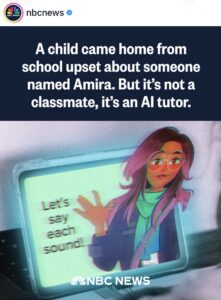
Well, and if you do call it your Alexa bot or Alexa AI. So it just distinguishes, like it’s not a person. Right. So we had this. What was interesting about this is she brought this point up when we were collaborating about these talking points. And then several weeks later, I see this thing posted on NBC News. And this is this is what it says. A child came home from school upset about someone named Amira, but it’s not a classmate, it’s an AI tutor. You had already told me that. And I saw this and I was like, that is the power of naming technology.
SPEAKER_02 16:07
Well, and I think the parents didn’t understand that they were talking about a computer, right? They thought they were talking about a real human tutor that was not being kind.
SPEAKER_01 16:15
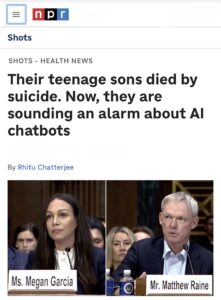
An actual class hasn’t been well programmed. Yes. And so we’re we’re seeing this. AI reminds me of what I was seeing 15 years ago when I first got into this digital safety work. We were forming our nonprofit, the wave of social media that hit. And we were just unprepared for it. And all these weird things started happening, right? And now I’m seeing that with AI. All these, there’s this new wave, all these weird things are happening. And devastating things are happening. Devastating, I mean, kids losing their life. You know, some AI uh apps are being sued by parents because they’ve created this companion and then they’ve gone to them with mental health issues, and the AI didn’t give good advice. Some kids are losing
Why Naming Bots Changes Everything
SPEAKER_01 17:02
their lives to AI. So it again, it’s that new wave. So we’ve got to be prepared and know what’s happening. And with this naming stuff, the more you’ve talked to me about it, and then the more I’ve seen these stories coming out, I keep thinking, man, it’s a slippery slope because these kids are thinking, this is my best friend, or this is my boyfriend, or this is my companion.
SPEAKER_02 17:23
Well, when they trust it with a little, then they don’t understand why they can’t trust it with a lot. And that’s just the way it is. It’s it creeps in little by little with the trust. And then the next thing you know, you’ve lost control of that. So in my case, I would not name it. And it’s interesting because I decided in preparing for the show, knowing that how I felt about naming an AI, I asked AI what it thought about it. And it was, it’s interesting because it said I would not make, quote, never give Alexa a personal name a major point. The larger issue is whether the child was being encouraged to believe a device knows, loves, or needs them, which the second part is great advice. But I did think it was interesting that AI itself is programmed to want human qualities and it wants to be named, is how I took that, which actually makes me not want to name it even more. So I think it’s good to be aware of that. And if you have littles, just start it early. Start calling it a computer, start calling it the bot, start calling it mommy’s helper, but not somebody that you value and as a family think about what we’re gonna call our companion.
SPEAKER_01 18:31
Or just say, let’s ask AI, right? And then it’s it’s AI. Right. But instead of calling it like a pet, and then it becomes a personal, we’re pushing our kids into this personal companionship without realizing we’re doing it. Right. And they don’t need one more thing that’s pushing them towards that.
SPEAKER_02 18:48
They already have that with just with phones and notifications and all the things that have to be done on a screen anyway.
SPEAKER_01 18:54
One of the things I love about the work we do at Next Talk is of course we need to watch these new digital trends and we need to raise awareness for parents. But the Next Talk solution focuses on the relationship, building a healthy dialogue with your child so that whatever the next wave is, because there’s going to be another after AI wave of technology that the relationship can hopefully prevent and protect your child. That’s the key here. And um that’s our focus. One of the things that I get so frustrated about, Meredith, is when other digital safety organizations come out and they’ll be like, we are an AI expert. We know this and this and this. For sure. Wrong. Nobody is an AI expert right now. This is the first time AI has meshed with our kids and we don’t know how it’s going to affect them. The same way social media did 15 years ago, and now we’re saying, uh-oh, we shouldn’t have done that. Here’s the thing that I want to say we’re not, we’re not saying we’re AI experts. We’re learning every day. That’s why we are using it to see how it responds. But what we are saying is we’ve been in digital safety space for 15 years. We’ve seen a lot of digital trends come and go. And we’ve seen the most success in keeping your kids safe is you being the safe place. You’re the solution. And that requires a lot of hard work on our part as a parent.
SPEAKER_02 20:20
It sure does. But we want you to be the hero in your family. We want you to be the one that knows about AI and the dangers and the risks ahead
Real World Harms And False Trust
SPEAKER_02 20:28
of your kiddo and making a plan for your technology and a plan for those conversations as your family grows.
SPEAKER_01 20:35
Yeah. And what’s so cool too, Meredith and I, now we’re both empty nesters. Welcome to the club. Don’t even, it’s just been a couple of weeks. It’s just been a week. I can’t. It seems like it’s more, but it seems like a lifetime. Yeah. Every day has felt very quiet around here. But one of the things that I’ve really appreciated about the solution of Next Talk Us, focusing on the relationship, is yeah, it kept my kids safe online. When one of my kids knew something was not right, it created that environment where they would talk to me. But now that I’m an empty nester, man, pouring into the relationship all those years, now they’re out of my home. Like I just never realized I want to create a home where they want to come home to. And it’s just been such a blessing, them calling, texting, planning visits.
SPEAKER_02 21:24
And I’m like, wow, had I start telling you heads up stuff to tell Next Talk parents. Yes. That’s one of my favorite things is mom, did you see this was going on? Or be sure you tell the parents about this. And you’re like, oh, it speaks your love language.
SPEAKER_01 21:39
It’s it’s precious. And all those years ago when my kids started being exposed to things, my default was just no phones, all the rules. I’m so glad God got a hold of my heart and changed me into the relationship. Like, like rules are important. Delaying the phone is important, all that stuff is so good. But if you don’t have the Relationship, it’s not gonna work. And now, I mean, yeah, it keeps your kids safe online, but man, it creates a family generational cycle where there’s healthy relationships.
SPEAKER_02 22:12
Of healthy relationships for sure. Well, and like we said before, when we get questions from the parents, it’s it’s just always something. I wish it wasn’t. I wish it wasn’t always something, but it is, and that’s how the world works. That’s how parenting in an overexposed world, like we say, um, it works, but the conversations will prepare you. But beyond that, I did want to highlight a couple things that we would recommend to parents who find out their kid as having an AI boyfriend. I remember also we heard once from a counselor who told us that they had kiddos that said their counselor was AI. Do you remember that? So it’s kind of like anytime you’re digging in and discovering something going on that’s beyond just a bad mood or whatever, right? So wouldn’t we think like they gotta look in the phone?
SPEAKER_01 23:03
Yeah.
SPEAKER_02 23:03
You know, AI is not just something you use on a computer at school. They also have it in an app on their phones. And you got to get in there and take a look. Well, first you make sure your set their settings are all protected. You can set settings in that just like you do in any other social media or in any other apps, but look for conversations of secrecy. Look for things where your kiddo might be choosing to spend time on their screen when they should be with the rest of the family, you know? And specifically, anytime the bot itself is discussing relationships and sexuality, telling telling you not to tell the user not to share it with someone, our secret. It’s almost like the same things you would teach
Relationship Is The Safety Strategy
SPEAKER_02 23:48
for the red flag alerts, but this time it’s through a bot.
SPEAKER_01 23:51
Well, we helped one family too, and this was a while back. Um, little girl just doing research for school, found a website. It looked like a character type website. She started chatting with the characters, you could text them, and it actually started telling her how to touch herself to feel certain things. So basically, you’ve got an AI bot telling a young girl how to masturbate. And so the parents found out, obviously, they called us. I got on to kind of see what was this, and it was an AI porn website where you could communicate back and forth with these porn bots, and it would tell you how to do certain things. So anytime you’re noticing behavior change or your kid just seems off, you know your kid better than anyone. Push into that. You know, Merida said random phone checks. We did a show on that. That is always something we advocate for. No screens in bedrooms or bathrooms. So, so like this would help prevent them getting into a private space, touching parts with a phone. We don’t want that. We don’t want to create any bad habits. So, all of these things are super important to do as you’re uh navigating and building the relationships and having these preventative conversations.
SPEAKER_02 25:11
Getting curious about what their influence is and what they’re where is it coming from? So, you know, hi, I have a chat boyfriend or an AI boyfriend might be the statement coming from the kid of, well, what does that look like? And you should have access to be able to find out what through the random checks and digging in more. And you can search all those chats. I actually think you can even pull some up that have been deleted. It remembers the conversations, even if you delete the conversations. So I would definitely recommend to a parent, you know, besides number one, don’t go crazy paramount on them and listen to them and find out what’s really going on, but also do a little protective work there to make sure your kiddos being safe and where how they’re spending their time. Get curious and dig deeper.
SPEAKER_01 25:56
For sure. Yeah. Definitely. Without judgment. Yeah. Yeah. You know, with my youngest son, AI became more of a conversation in our home because over the last several years it’s kind of blown up. And, you know, one of the ways we would talk about it was use it for practical things. Like we can use it to find restaurants, we can use it to plan recipes, we can use it for vacations. We do that a lot. Use it on, you know, we’re looking for a place to visit like this and see what it recommends. Those are all good and practical tools to use AI for. I would always say any kind of feelings, relationship advice or thoughts, uh, deep thoughts about your mental state or relationships, those need to go to a human because AI is not going to be able to give you the right advice on that.
SPEAKER_02 26:43
Well, it doesn’t have any lived experience. And I think that’s one thing that’s so it feels like it feeds you answers based off of some vast knowledge that humans don’t have. And in a way, it does because it validates
Red Flags Phone Checks And Settings
SPEAKER_02 26:55
off of patterns. It is constantly seeking patterns and trying to validate humanity by what we feed it. And so it feels very real. I mean, everyone struggles with it. We all make jokes about it, about how it’ll say L O L back to you and you have to tell it. Please don’t say that to me. You’re we’re not friends. And but it very much is designed to mimic what you put into it. And so it isn’t ever going to be a substitute for authentic relationships. Ever. But it wants to be.
SPEAKER_01 27:28
It’s funny because we always talk about boundaries with real people. We need to have boundaries with AI. Oh, good. Like what you just said. We’re not going to talk about that.
SPEAKER_02 27:36
Let’s stick to this. Well, I’ll give you an example. I was recently on a vacation and uh with my daughters, and I was asking it like something about whether we should stay in a hotel or an Airbnb, something simple. And I was having it kind of help us along. And I was reading the responses to my young adult daughters, and they both looked at me so strangely and they said, Why is it responding to you like it’s part of our group? And I was like, that’s a great question. But because at first I didn’t notice it because it is mimicking the way I talk, because that’s what I’m the one putting it in. So it’s mimicking what I talk. So you can see how with children it can really distort what they value in a relationship because it’s just feeding back and mirroring back the way they talk. So it can feel so safe. And, you know, it’s always available for you, it’s always there. It’s never gonna make you feel dumb. It’s never gonna make you feel like you didn’t wear the right thing to school today. If you tell it what you’re wearing, it’s gonna tell you that looks great. You look great. You should be proud of yourself. It is a continuous validation, but by nature, it can validate a warped idea or a warped thought. It can affirm you when it’s wrong. Absolutely. And that’s what it was doing on vacation. Everything I told it, it kept saying, I think that’s a wonderful idea. I think that’s a great idea. And finally, I said, Stop telling me that.
SPEAKER_01 28:56
And I logged out of it because it’s a little creepy sometimes. AI does not have discernment.
SPEAKER_02 29:02
There it is.
SPEAKER_01 29:03
It does not have discernment. And we need to make sure our kids know that. In fact, I’ve used teachable moments like that too when I’ve asked AI something and I know it’s wrong. Like all, like a lot of times in the work that I do, I’m like, who said this? Like, because I’m finding a quote that I want to use and I want to make sure I give proper credit. That’s very important to me as an author. And so I’ll be asking AI and they’ll say, This person said it. Like, and normally it’s like an influencer or something. And I’m like, no, no, that is not the first person who said that. I know there was a book written on this. Go back and search. And I’ve argued with it to the point where it will say, Oh, yeah, it we’ll get there. We’ll get to the point where where the where AI will say, Oh, yeah, you’re right. That was published in a book in 2013. And it’ll say, You’re so smart. But this influencer said it and it went viral. And I’m like, well, then the influencer shouldn’t get credit for that. And they’re getting paid for that. That’s a whole other conversation we can have.
SPEAKER_02 30:04
It’s
Healthy AI Use And Firm Boundaries
SPEAKER_02 30:05
another topic.
SPEAKER_01 30:05
On somebody else’s work. When I see AI being clearly wrong, like I’ve told my kid about it. Like, this is why you can’t trust it. And so use those teachable moments just like that. Don’t be afraid of AI. Don’t ban AI, but come alongside of your kid, learn it together, and then create these conversations so they are able to discern because they are humans and they can.
SPEAKER_02 30:30
Well, and as far as banning AI goes, it’s a slippery, slippery slope because it’s in everything. Yeah. It’s it’s in our Amazon orders, it’s in all social media, our Google searches, everything is being driven by algorithms that AI feeds into based off of our patterns. So you’ve got to learn that as a parent, acknowledge it as a truth. It’s it’s there. Yes, filter them as much as you can, protect, delay, all those things are great. But you have to, as a parent, recognize that that’s coming alongside your kiddo in the culture that they have to grow up in. And so they need to learn now that they’re not humans and that they’re not there to validate them. And digging in with the AI, when I was asking it about naming it Alexa, it criticized itself, which I thought was interesting. It wanted to be named, but it also told me something that I thought was really good that it says that AI does not have dignity. And I thought, you know, that is a human characteristic based on who you are and your actions and your value and what you bring as a human being to the table is your dignity. Your faith pours into who you are and your dignity. And AI itself recognizes it doesn’t have that. And so I just think it’s super important for parents going forward that they acknowledge AI exists, it’s a tool, where it’s at, why it’s at. But for their kids, who are the people that they’re safe with as a relationship and be that, model that in your home so that they’re not so driven to seek it outside of outside of the house.
SPEAKER_01 32:10
One of the big conversations going forward with technology is going to be this differentiation between humans and technology. When my kids were growing up, one of the things that I would always say to them about online influencers was they don’t get more of a say in your life than an adult that has earned your respect.
SPEAKER_02 32:31
And you know, they’re even way more prominent now.
SPEAKER_01 32:34
Exactly. And so this is the same conversation that we’re talking about with an AI companion. But parents have to be intentional about the separation
Faith Perspective And Next Steps
SPEAKER_01 32:45
and making sure kids really understand the difference.
SPEAKER_02 32:48
Right.
SPEAKER_01 32:48
Yeah. So many things to talk about with it.
SPEAKER_02 32:51
But parents can do it. You’ve got it. God called us for a time of this.
SPEAKER_01 32:56
And none of this takes God by surprise. That is why I believe in Deuteronomy 6, 6, and 7, he says, talk with your kids, focus on building the relationship. Because he knew if we had that foundation, any wave that comes along, we’re going to be able to keep our kids safe.
SPEAKER_02 33:14
Exactly.
SPEAKER_01 33:14
God knows best, not us. We started with saying we sent out a newsletter. We send that out to about 4,000 parents. I would love for you to sign up. I send an email, it comes from me every other week. So we’re going to put a link where you can sign up for the newsletter if you’re not already, or you can go to our website and sign up there. Thanks for joining us today. I really wanted to cover these two talking points. One, don’t shame your child for wanting connection. And two, don’t settle for fake when you’re made for real. But also wanted to bring in Meredith and all of her wisdom. She’s kind of representing our team and that whole conversation that happened on these additional talking points. But more than anything today, I hope you feel supported as a parent. You are not alone navigating the digital world. If you ever want to send us a question, you can reach out to me directly. I’ll put a link where you can submit your own question, or you can also always email us at admin at next talk.org. Hang in there, parents. We got this.
SPEAKER_00 34:19
Next Talk is a 501c3 nonprofit. Everything we do to serve families is supported by people like you. Make a donation today at next talk.org. Next talk resources are not intended to replace the advice of a trained healthcare or legal professional, or to diagnose, treat, or otherwise render expert advice regarding any type of medical, psychological, legal, financial, or other problem. You are advised to consult a qualified expert for your personal treatment plan.
This podcast is not intended to replace the advice of a trained healthcare or legal professional, or to diagnose, treat, or otherwise render expert advice regarding any type of medical, psychological, or legal problem. Listeners are advised to consult a qualified expert for treatment.
Subscribe to our monthly newsletter for all the latest podcast titles, events, and nextTalk news.
nextTalk started in a church with a group of parents who were overwhelmed that their young children were being exposed to sexualized content. Today, we’re a nonprofit organization in the state of Texas and an approved 501(C)(3) entity by the Internal Revenue Service.