The Fentanyl Conversation Every Parent Needs to Have
Matt Riviere never imagined that one decision would take both of his sons, Andrew and Stephen. At 21 and 19, the brothers purchased what they believed was oxycodone through Snapchat. The pills were counterfeit and contained fentanyl, and both young men died. Matt joins Mandy to share their story and help parents understand how quickly counterfeit pills, social media, and experimentation can become deadly.
Subscribe



The Fentanyl Conversation Every Parent Needs to Have
Matt Riviere never imagined that one decision would take both of his sons, Andrew and Stephen. At 21 and 19, the brothers purchased what they believed was oxycodone through Snapchat. The pills were counterfeit and contained fentanyl, and both young men died. Matt joins Mandy to share their story and help parents understand how quickly counterfeit pills, social media, and experimentation can become deadly.
YouTube
Meet Our Guest
Matt Riviere is a Colorado father and advocate who lost his two sons, Andrew and Stephen, after they unknowingly took counterfeit pills containing fentanyl. Since their deaths, Matt has dedicated himself to educating parents and students about the dangers of fentanyl, counterfeit prescription drugs, substance experimentation, and drug activity facilitated through social media.
Matt has worked with other families on fentanyl-related legislation in Colorado and advocates for greater social media accountability and online protections for children, including work connected to the Kids Online Safety Act. By courageously sharing his family’s story, Matt hopes other parents will have conversations he wishes he had known to have with his own sons.
Sources & References
Free Guides
Additional Podcasts
Transcript
Cold Open: You’re Gonna Lose
SPEAKER_01
You’re gonna lose, and that’s what I tell these kids. You’re gonna lose. Might not be the first one or the second one, but if you keep playing the game, uh you’re gonna lose. I just wish I would have known what fentanyl was, and I wish I could have had that conversation with my kids, but uh I didn’t know what it was.
Meet A Dad Turned Advocate
SPEAKER_02
Welcome to the Next Talk Parent Podcast. I’m your host, Mandy Majors. Together as parents, we’re learning how to navigate tech, culture, and faith with our kids. We share real stories and real hope as we fight to keep our kids safe in a digital world. Today we have Matt Rivier on the show. He is a Colorado father who has a story to tell so we can warn other parents and keep kids safe. Matt, thanks for being on the show today.
SPEAKER_01
Thanks, Mandy, for having me. I’m I’m very fortunate and blessed to be here. Thank you.
SPEAKER_02
Tell us about your family.
SPEAKER_01
Yeah, I had a great family. I was married for uh over 26 years, and we raised two wonderful boys, Andrew and Stephen. And uh we were really close. We we had a lot of fun together. Uh, we went to church together, we did youth ministry together. Uh, my wife and I were very involved. Uh, so many of their friends uh used to come to this home where we would uh you know host pizza nights and Halloween and birthday parties, and we were just a very connected family and just loved being with each other.
SPEAKER_02
Tell me about Stephen and Andrew.
SPEAKER_01
Well, Andrew, my oldest, uh, he was my mad scientist uh out of my property here. He would always go out and create things. Usually they would he’d blow them up. Uh, he loved uh loved the the loved to do that. So he would watch YouTube and he’d watch experiments out there and he’s hey dad, I’m gonna do this. And so uh he’d he’d do that and he was really talented with his hands. Uh he also liked to make music. Uh he played guitar. I remember one year I said, I’m gonna make my son cry at Christmas. He was a young boy, uh, and I meant that in a good way. And I got him a guitar and it was the last gift. I came around the corner
Remembering Andrew And Stephen
SPEAKER_01
and strummed it, and that kid just broke in tears, so soft-hearted uh to see this guitar, and he was so excited, and uh that kind of took him off to make music with his younger brother Steven. And Stephen was my athletic and academic kid. He graduated high school with uh an AA degree right out of high school, and he had over a 4.2 GPA. Uh great wrestler, very athletic. We shared that love of athletics together, was a great wrestler here in Colorado Springs, was 26-0, his uh eighth grade year, and we had friends around that were actually in the Olympics as wrestlers, and so he had some great people around him encouraging him.
SPEAKER_02
Wow, and they were close as brothers, they were close. I mean, I’m sure they had the sibling rivalry too, right? I mean, that’s normal.
SPEAKER_01
Yeah, they were. They’re two, they were 20 months apart. Um, and I like to say they were best of friends, worst of enemies. So uh, you know, we are a very affectionate family. We, you know, one minute we’d be hugging, and the next minute, you know, uh sometimes they went to fisticuffs, and my wife and I learned very quickly, uh, put them outside, especially on a snowy day, uh, and then they’d start working together to get back in the house. That was one of our parenting techniques that we used when they uh kind of got at each other.
SPEAKER_02
So I met you through Maureen Molack, and and our listeners are no stranger to Maureen Molack. You do a lot of advocacy work for her on the Kids On Land Safety Act and in DC and in Colorado, too, where you’re from. Um, tell us what you got how you got into that advocacy work because that leads into the story of your sons and what happened to them.
SPEAKER_01
Absolutely. So my advocacy work really began uh after my boys passed away in 2022. We worked on the Fenso Accountability and Prevention Act here in Colorado. First time I had ever done something like that. Uh, I was asked by a local group to come testify at the Capitol. And I worked with other families as we we got that uh bill into law. Uh over the years, I continued to work on that. And then we started to pivot to social media. And last year, sat before the Capitol again, talked about the social media harms, and uh, we got this great bill uh literally passed in Colorado, but it unfortunately got vetoed by the governor. But as part of that legislation, uh one of the moms in in the group with Maureen said, Hey, what do you think about doing this at the federal level and advocating for social media reform? And I said, That sounds great. And that’s how I met Maureen and the other incredible parents that we’ve been working and advocating with and lobbing Congress to get the Kids Online Safety Act passed in Congress.
SPEAKER_02
Take us back to the beginning because some of our listeners said, when my when my sons passed away and they don’t know your story. So take us back and walk us through how your kids were harmed by social media and what happened with them.
The Snapchat Deal That Killed Them
SPEAKER_01
Yeah, so it’s interesting. My kids, uh Andrew was not 21 and Stephen was 19 when they passed away. And that was back in 2021. So it’s just on the other side of five years now. They were on social media early on, right? We didn’t really understand the harms, the uh addictiveness of it, uh, the mental health issues that have arisen that we’ve seen uh played out in the courts today. Interesting that in my family, I think I want to frame this is that my my wife of over 26 years, sadly, she was bipolar and had some challenges with that. Andrew was bipolar as well, and Stephen struggled with anxiety and depression. And so here they had these challenging mental illnesses. And now I look back, Mandy, and I see wow, social media, we didn’t understand it, but I I absolutely believe, and I don’t want to embellish it, but it definitely uh exacerbated their mental health conditions because we were the family, and I’m in IT as a director. I was the dad that turned off the internet when we went to bed. Uh, we blocked sites, we had filters. Uh, my kids had very limited data plans, like back in the day, they could only get like a gig, and that was it. And when the data was gone, it was gone. We didn’t allow computers in the rooms, we didn’t allow phones in the room, so they had to sit in the front room. And so we we tried to take precautions again, way early in the social media because we didn’t understand it. Uh, I remember going on a one-on-one tie with my son, and he showed he showed me Snapchat at uh a burger place, and we made fun pictures together and put ears on each other and changed our faces. And he just told me about Snapchat. I had no idea. I thought it was an innocuous app just to chat with his friends. Uh later on, ironically, that was the platform where my kids ended up getting uh the deadly drug that took both of their lives in July of 21. And so, you know, I looked at my family, had some mental harms going on, right? Mental challenges. Uh, my wife went into a bipolar manic episode uh in March. And within four months, my kids uh were were killed by experimenting with what they thought was oxy, but it turned out to be a counterfeit pill that was laced with deadly fentanyl. And when the uh law enforcement called me and they said, Mr. Riviera, we we think your kids uh have died from a fentanyl overdose. Do you know what that is? I I had no idea what fentanyl was. I thought it was the drug that killed Michael Jackson, and they said, no, no, no, that was other stuff, but it’s what killed Prince. And so I just made I had no idea what fentanyl was. I I hadn’t heard of it. Uh, and then since then I’ve been drinking through the proverbial fire hose since that time, learning about fentanyl and how deadly it is, and how it’s just going across the United States, taking so many lives every day.
SPEAKER_02
So they were together and they got this pill off of Snapchat from a dealer on Snapchat that they thought was a sort of painkiller that they were right, uh Oxy, uh, that’s what you’re saying.
SPEAKER_01
Right, right.
SPEAKER_02
I want to I want to make sure I understand, but it was actually fentanyl. And they were they both passed away in the same night from this one interaction on Snapchat with this pill.
SPEAKER_01
Yeah, and so they they got their pills, this pills on Snapchat. Um they ordered DoorDash that morning. It was early in the morning, it was like 3 a.m. They ordered DoorDash, thought, hey, we’re gonna have a great time. They ordered a breakfast, one kid ate his meal, the other one didn’t. Um, took this this drug. We talked to the roommate, and she said, Hey, we I’ve never they never tried something that that before. Um, they were messing with other things, which we can talk about. And then uh they ended up finding them a day later side by side in their bed together, just like they were when they would sleep in their beds. One kid had his hand under his head. Uh when I’d go and kiss him goodnight, that’s what he would be like, and that’s how they found my youngest son.
SPEAKER_02
Matt, I just I’m I can’t imagine losing both children at one time. Like I can’t, not even just one child, but both children. Through the same problem, through the same situation. And we’ve had, we have a guy come on our podcast, Talk Hawk. I don’t know if you’ve heard of him, but he educates about drug dangers. And we did a show with him years ago about the dangers of fentanyl. And the one thing I learned was how deadly it can be with one dosage. And most parents don’t realize that.
SPEAKER_01
Absolutely.
One Pill Can Kill Explained
SPEAKER_01
It is uh when I go into the schools and I talk to kids, there’s a lot of things that I share with them. But one of the things that maybe you’re hitting on is how deadly it is. It really goes so well with the DEA’s campaign of one pill can kill. And honestly, it could be half a pill because these counterfeit pills that kill my kids, uh, there’s no quality control. They’re made by the cartels. They mix it together like witches’ brew. They press it into pills. Some are deadly, some are not. And it only takes two milligrams of fentanyl to kill the average human. And so, if you think about what two milligrams look like, about nine to 15 grains of salt. So I remember when I testified at the Capitol that one family shared how their daughter and her boyfriend split a pill, and their daughter died, and the boyfriend lived. And he was so overcome with remorse the next day, Mandy, that he killed himself because he felt responsible for the death of his girlfriend. And that was half a pill. Another mom I were I’ve met right after my kids passed away. They came to his memorial and they reached out to us to my boy’s memorial. Uh, a quarter of a pill that he got at the X Games in Colorado. So sad. So it’s what I tell the kids, it’s it’s I’m gonna be graphic. It’s Russian roulette, but it’s not with one bullet in the chamber. It’s not with two, it’s like three to four bullets in the chamber. And that’s what these kids, this is a game that they’re playing, and it’s they’re gonna lose. And that’s what I tell these kids. You you’re gonna lose. Might not be the first one or the second one, but if you keep playing the game, uh, you’re gonna lose.
SPEAKER_02
Most of the people who listen to this podcast are parents. So how can we have this conversation at home with our kids right now? Because I know I was getting familiar with your story before my son left for college. And I was telling him, you know, don’t even take medicine from people you don’t know, any pills, anything that don’t ever, because you never know that it could be laced with this, and there’s no time to fix it. I mean, it’s the pill that kills exactly what you said with the DEA campaign.
SPEAKER_01
Absolutely. And and so you you look at the pill that killed my kids, known as oxy, a little blue pill, they call it an M30. That is probably the predominantly widest known fentanyl pill that’s out in the market. You’ll see them all over the place. So, but the cartels have taken not only do making fake oxy, but percocet, Xanax. There they’ve created uh fake Adderall, which is incredibly scary. When we had a shortage a few years ago in America, they decided to take that on and create fake Adderall. And so you imagine those kids that couldn’t get the prescription Adderall, and then they have a friend, oh, I’ve got some, but it’s really not Adderall at all. It is fentanyl uh hidden in a pill that looks like Adderall. Uh, they’re mixing it in heroin, which is crazy. And I’ve talked with two kids that have lost friends that smoked uh a joint, and their friends smoked the joint and it killed them because that marijuana from the street was laced with fentanyl.
SPEAKER_02
The N30 pill that you were talking about, I did some research on that. So that is the what they think is they’re buying a painkiller, the oxy, and it looks almost very identical. Just the blue is a little bit off, right? Educate our listeners on that, how closely it looks like oxy.
SPEAKER_01
Absolutely. These pills, for us as parents, there we are not going to know the difference. Uh, the way they take these, the way they color them, the way they press the inscription into the pill. Uh, you’d really have to be an expert. And I show these kids, hey, well, here’s a fake one, here’s a real one in terms of pictures. We wouldn’t be able to tell. And so these kids unknowingly are taking these oxyimpercocets and xanex, thinking that they’re real, because they don’t know the difference. And again, neither would we. And it turns out to be just a pill with binder coloring and fentanyl.
SPEAKER_02
So I think one of the conversations for parents too is like never buy any kind of drugs online through a social media app, correct? I mean, that’s one of the things we probably should be telling all of our children.
SPEAKER_01
Absolutely. If it doesn’t come from a reputable pharmacy like a Walgreens or a CVS or a Walmart pharmacy, you you cannot trust it. That’s I tell kids, it’s you cannot trust anybody, your friends, even they they swear in their mother’s grave that they know where they got this. You you cannot trust it. It’s again Russian roulette, and these kids are dying every single day.
SPEAKER_02
What other conversations should we have with our kids at home?
Courageous Drug Talks With Teens
SPEAKER_01
I like to call these courageous conversations, Mandy. Um, they’re awkward. Uh parent to parent for those listening. These are incredibly awkward conversations. Kids aren’t going to want to talk about this. Uh, we actually had conversations with my boys up to this. So I can’t say that this was an utter shock in a sense that wow, they went from nothing to this. That that was not my boy’s story. And we had conversations when they first got onto vape when vape hit the market. That’s where my kids started. And my wife and I were like, nope, we don’t do we don’t do vape in our house. Thank you very much. And we confiscate that that vape. And we talked about it. And we again, we didn’t even know what vape was doing at the time with the heavy metals and how it would affect the brain and the central nervous system. And then the nicotine, and my son got addicted to nicotine and went through that. But you know, we we as parents, we just didn’t allow that. Um, of course, kids are gonna get what they want to get, and it might not be in the four walls of our home, but they’re gonna get it out there. And I I think it’s so important. And one thing that I feel great about that my wife and I did is we had one-on-one times with my kids as they were growing up and into their teen years, and even when my youngest son moved out of the house up to the time he died, we had these times where we’d go out and we would get lunch together and or dinner and we would talk and we would talk about these uncomfortable things. And he he would tell me, Dad, I tried this. And I’d say, Son, what are you doing? Like, please don’t throw away your life to do this stuff. And my wife and I were never around drugs. We didn’t do that, wasn’t part of our life. Uh, I didn’t even experiment with that because I wanted to be a Navy fighter pilot. So this this was a new world that I hadn’t dealt in specifically, but my boys were experimenting, and I just look at them dialing it up over time. And so, parents, you you’ve got to talk with your kids. Uh, it’s no different than talking with them about sex. Uh, you know, you do your best, you have the awkward conversation, you follow up with them, but you you’ve you’ve got to approach this because this is affecting every corner uh of the United States.
SPEAKER_02
One thing that Tolkop has said is everything is a gateway to something else, you know. And he said also don’t compare drugs. You can’t say, well, it’s just a vape and it’s not this, right? They they they all are creating a substance habit that we need to look at the bottom line. And I thought that was such wise advice that he said.
SPEAKER_01
That’s great advice. I hadn’t heard that, but it’s it’s true. Nicotine is is incredibly addictive. And we know that, right? From big tobacco, uh, and then vape came out, and we got kids that are addicted to nicotine. My son went through that, the wrestler Steven. And I remember when he wanted to get off that, he’s like, Dad, I got to get off this. And he went cold turkey. He was miserable, and so are the rest of us because he was not a very happy kid to be around while he was coming off that substance. But then it it’s I look at my kids’ story, it’s just dialing it up. Then they decided to vape THC. And then it was, you know, smoking marijuana. Then it was doing dabs, which are is now the big thing, this high potency THC, which is incredibly addictive. Uh, it creates psychosis and can lead to kids’ schizophrenia. And so I look at that journey as that I look at my boys trying these other substances and ultimately trying what they thought was oxy. It was just a dialing up. Okay, I got high on THC. Hey, let me try this, little knowing that it was going to cost them their life from an experiment.
SPEAKER_02
You always think you have time to have the conversations, but the dangers with this particular one, fit and all, is that it’s so fast acting. I mean, the fact that it happened in they ordered DoorDash and then were later both deceased just shows how fast it is. And you j we just cannot reiterate how much. I I I think I know you said it was harsh set plex when you said playing Russian roulette, but that is a good way to describe it. And I also think another conversation that needs to be had with our kids is somehow in the back of their brain, if it’s a medicine prescribed by a doctor, then it’s okay, even if they bought it online. And we need to have that conversation as well. That that perfectly normal medical drugs done in the right setting is fine under a doctor’s orders and through a legit pharmacy, but taken out of that context is where there’s extreme danger.
SPEAKER_01
Yeah, absolutely. My kids tried oxy. Uh, they didn’t know it, they didn’t know it was fentanyl. I I didn’t even get like I said earlier, I didn’t even know what fentanyl was. I would presume they probably didn’t either, but here they are taking an oxy out of context, right? They didn’t take it for pain relief. They thought they they did it to get high and see what this is gonna do. So, yeah, using any type of prescription drug. And we saw that right with a big opioid settlement here uh across the United States. I sit on the opioid council in the springs, and with all the millions and billions of dollars that these companies have been paying the states, you know, we’re trying to figure out as a council how do we help people with addiction and recovery? And then how do we keep youth from even going down the path that my kids took? And so, Mandy, you’re right, these prescriptions drugs, it can be a gateway into this. And once you go to the streets, they the DEA says 98% of illicit street drugs are laced with fentanyl. That’s incredible. They’re not making oxy, uh generic oxy, they’re they’re making a counterfeit oxy, and they’re using fentanyl because it’s incredibly cheap, incredibly addictive, and it’s easy to manufacture because it’s a synthetic opioid. They don’t have to grow it, they just make it with basic chemistry.
SPEAKER_02
What have you learned the most about the dangers of fentanyl that you want to share with our listeners?
SPEAKER_01
So when I go into the schools and talk to kids, you know, I share my boy’s story. It’s so important because I think, first of all, regular kids, my kids were good kids, but they were making bad choices, and I am not going to excuse their bad behavior. You should have never done what they did. And I can hear my youngest son saying in my head, Dad, that was so dumb. Okay, kids are gonna make dumb choices. I made dumb choices when I was in high school with alcohol, got behind the wheel to my shame. Thankfully, I didn’t kill myself or somebody else. But parents, your kids sadly are very vulnerable with the peer pressure, with the advent of social media, uh, with all that pressure that they’re feeling, and then the mental health crisis on top of that. Sometimes they’re just they’re just going to these substances to medicate their pain. And so I look at uh At fentanyl, it is 50 times more potent than heroin. Heroin was it was an incredible drug when I was back in high school. Black tar heroin and addicts were dying from that, but now they’re putting fentanyl into heroin and it’s 50 times more potent than that. It’s a hundred times more potent than morphine. I mean, this stuff has no place to be ingested uh by a human. This fentanyl was designed back in the 60s as a pain reliever. And when it’s given to victims of extreme pan, maybe uh burn victims or amputees, they’re giving this stuff in what’s called micrograms, which are millionth of a gram on a uh a fentanyl shot, uh, two milligrams. Those are thousands of grams. As I said, that’s lethal to you and me. And so there’s they’re just unabashed. These cartels are all about the money. It’s all about the greed. And if your kids die, oh well, too sad, so so bad. Uh, there are plenty of other people out there that are going to try this drug to either medicate their pain, get high, uh, or or to soothe their addiction.
SPEAKER_02
Well, and you say the cartels, and it’s coming across the border, I’m assuming, and that’s what that’s what you’re
Disappearing Messages And Accountability
SPEAKER_02
saying. But regular kids are buying this too, and then selling it to other kids, right? I mean, do we know anything about the person on Snapchat who sold this to your boys?
SPEAKER_01
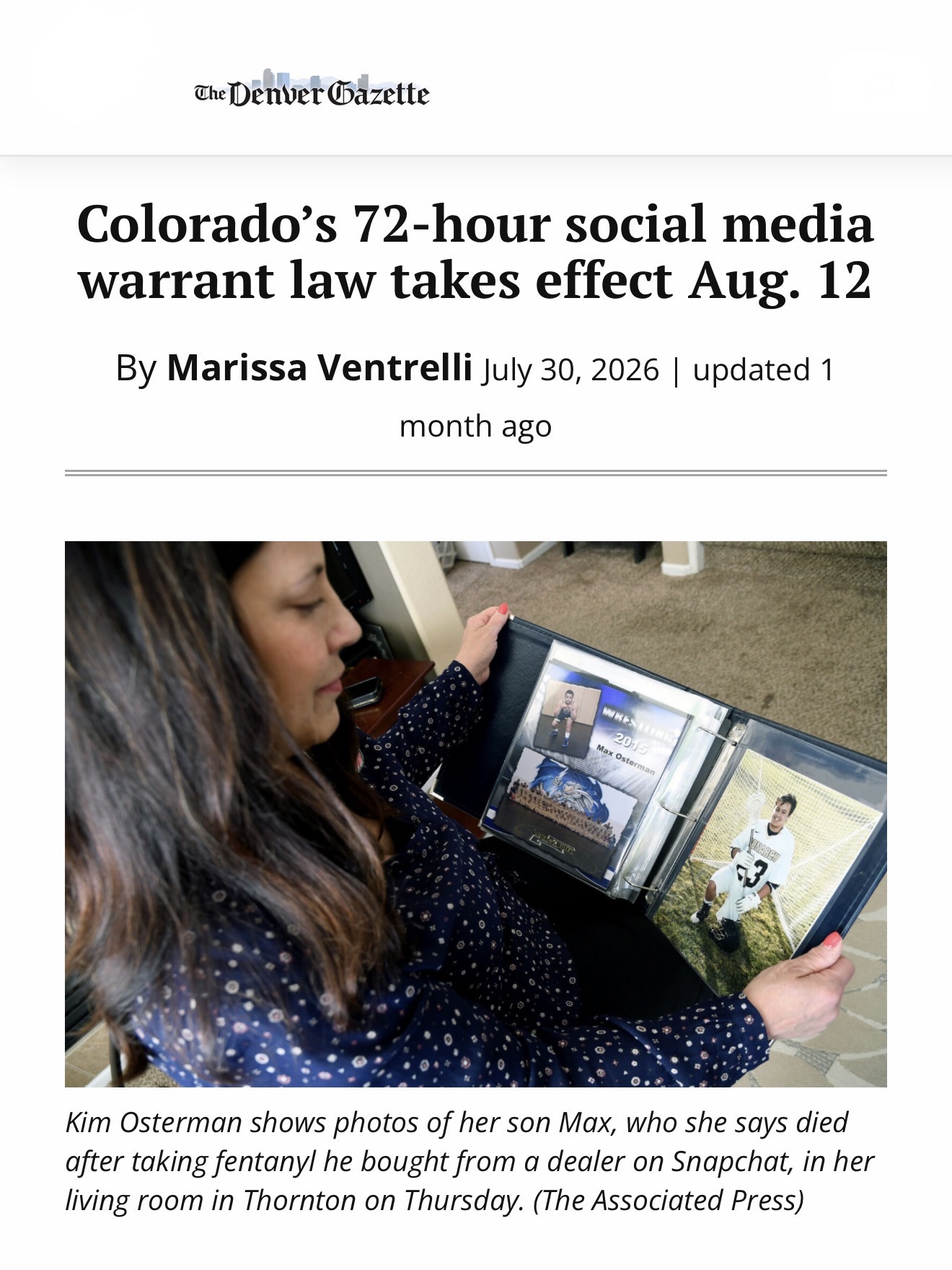
We don’t. We don’t, Mandy. You know, Snapchat, uh, they are known for their messages disappearing again. I found all of this out after my kids passed away. I thought it was cute video filters and a way to connect uh with your friends, but later I learned, hey, those messages disappear. And so one of the challenges that we’ve had with social media is that that data eventually, whether it’s it disappears by design like Snapchat, or over time, they’re gonna have to get rid of that data because they can’t store it all. Uh that’s incredibly scary because the authorities are not able to get to that data in time in order to do the investigation. So, with my kids’ case, as far as I know, there was really nothing they could they could do. I’ve had parents that who lost their kids uh to fentanyl as well using Snapchat. And by the time Snapchat responded, the data was already gone because they drugged their feet. And so I was so grateful that in fact this year the legislation that we passed in Colorado is holding social media accountable to the warrants that they get from law enforcement that they had 24 hours to acknowledge receipt of the warrant, and they had 72 hours to comply with law enforcement with the request. Otherwise, they’re going to be penalized financially. And so that was a landmark uh bill that we passed here just a few months ago. It just went into law. And that’s gonna help us to get to these sources of these drug dealers that they’re killers, they’re murderers. And I look at my kids again, they did not mean to die that day. I’m not gonna excuse their choices, but my kids were and many others, they they were murdered. They they should not have died from experimenting with a really a non-lethal drug, but it it was counterfeit, and so that’s where the lethality came.
SPEAKER_02
Well, you know, at our events, we talk about when we do presentations, next talk presentations, we talk about everything coming at our kids. And one of the things that we say is if you if you look at a chart of of health and human services data, if you look at that, we had a mental health crisis, um, major depression in kids more than doubled since the launch of Instagram. And that’s pre-COVID numbers. So we had a mental health crisis. Then you add in Snapchat, disappearing messages, and another disconnect from parents that we don’t understand it. And now you’re adding in dealers actually selling to kids on a platform that we’re just now trying to understand. I mean, this was all happening 2020, 2021 for you. So you got caught up in this first wave of all of these, this perfect storm coming together to attack your kids. And they were struggling themselves because they’re kids in a crazy world.
SPEAKER_01
Yeah, absolutely. And I think that what you said is exactly right. I think of it as it was a fire, and then COVID was gasoline on that fiber, fire, and then fentanyl was dynamite being thrown into that fire, and it just has exploded. And that’s why we’re seeing that the number one killer of adults 18 to 45 in America is not cancer, it’s not suicide, it’s not car accidents, it’s not COVID, it’s fentanyl. It’s fentanyl. That’s the number one killer in America, and we we don’t know that. And we’ve got these kids even younger than that, and they’re being killed by fentanyl every day. You know, one of the things I I to try to frame, Mandy, how bad this crisis is. And I I really followed COVID. I remember being and working as a leader in my company, uh, and we would track the deaths every day. We talked about it with my team every day, and we are seeing so many people lose their lives to COVID. And but to give you what I just said about it being the number one killer in America, fentanyl, it’s insane. And that continues year after year. And when my kids died, over 102,000 people lost their lives in America to drug-related deaths. And 70% of those were fentanyl-related. That I hadn’t, again, years ago, I had never even heard of that. And so, to put it into perspective today, about the equivalent of a 737 airliner fully loaded going down every day of the year, that’s about how many people die in America every day on average.
SPEAKER_02
This is things parents need to know. We need to know this is happening. We need to know they’re selling these drugs on social media to get to our kids. Um, this is so important that the work that you’re doing. You mentioned the Colorado legislation. That sounds like it is a move in the right direction. Do we have other states that you think will adopt this or have adopted it? And what about at the federal level also?
SPEAKER_01
Yeah, there’s not been uh, I’m not sure at the federal level what exactly has been done yet. It really is coming down to the states. Uh, with the social media side of it, I know California has really passed a lot of things. Uh, Maureen is so well versed in what states are doing what, because it’s this social media side is newer to me. On the fentanyl side, uh, it really is in the state’s hands. And uh when we made that uh bill pass into law in 2022, it was it was incredible bipartisan support, and we really increased penalties for uh drug dealers that were killing people and just possession limits, and then even helping people that were struggling with addiction uh in recovery. And so it it’s it’s not just about stopping fentanyl from coming to the country. That that’s just part of what we need to do. Uh, but it’s it’s the prevention and awareness. It’s the helping those that have come addicted to it, whether knowingly they purposely did it or unknowingly, where they were consuming a substance that they didn’t know had fentanyl in it, and now they’re addicted because only about three uses of fentanyl will get you addicted to that substance. And it’s a horrible, horrible thing to come off of. They say the withdrawals are so bad that those that become addicted feel like they’d rather die than go through that. And it usually requires medically assisted treatment. So we have to fund these municipalities to be able to provide that health care to these people that have become addicted to it. So it’s a it’s a huge multifaceted, multi-layered uh issue.
Turning Pain Into Prevention
SPEAKER_02
Well, Matt, thank you so much for you know just having the courage to share your story um, for sharing about your sons. They forever 21 and 19, um, and using their story to help other parents so so that we can protect our kids because we don’t know about this. Is there anything else that you would like to share with any parent listening today?
SPEAKER_01
Yeah, I think you’ve gotta going back, you’ve got to have this open communication with your kids. Um, they’re gonna make their choices uh many times behind your back. And I I think you’ve gotta make sure that you’re supporting your kids, you’re having these conversations, you’re doing whatever you can to help them. I my wife and I at the time did not agree with the choices my boys were making. Uh, we but we said, don’t ever drive drunk and don’t ever drive high. And uh even though we again did not support their decisions, we had that standing rule in our home, as long as they were into this house. And even when they when they moved out, that just let us know. Um, I I you know, I was hoping that that would keep them out of uh where they ended up. But you’ve gotta you’ve gotta be able to have those conversations and support your kids. If you uh are just judgmental and you shut them down, it’s still gonna happen behind your closed doors. You’re just not gonna know what’s happening. And so just having those open, vulnerable, awkward, yes conversations and just being able to share your like with them. I I think that was the one thing with my kids is that even though I didn’t do drugs, I made other choices, as I said earlier, with alcohol. And my kids wanted to hear the stories of my mistakes. And so I really was transparent with them with my life, uh, about every area of my life because they wanted to see that, yeah, dad makes mistakes, he messes up, and he, you know, he gets through it. And so that was really incredibly powerful. And I think that’s why my 19-year-old, when we continued to get together for those one-on-one times, I talked about that he continued to share what was going on. He didn’t have to share that stuff. He wasn’t in my house the last six weeks of his life. He moved out with his brother. So, because we established that pattern, Mandy, of open, honest, again, awkward conversation, he was willing to share that. And I could warn him as much as I could. I just wish I would have known what fentanyl was. And I wish I could have had that conversation with my kids, but I didn’t know what it was. But parents, now you know, and you’ve you’ve got to have that conversation. Or you you you might be the person that Mandy has on her podcast next that I would hate to see and have to hear another story of kids making these choices.
SPEAKER_02
I think that’s so well said, how you kept the lines of communication open, but then you had Snapchat and Fentanyl that was so fast-acting, and you didn’t know about that danger. And you you couldn’t talk to them about that yet because you didn’t know. And that’s what this show is about is about the awareness of fentanyl and and people using Snapchat and other social media platforms to sell it to your kids directly. And so that conversation has to be had today.
SPEAKER_01
Absolutely. Snapchat, as I say, it’s become DoorDash for drugs. Your kids get on it, it’s really easy. These drug dealers hide behind these accounts. The accountability on social media just hasn’t been there. Uh, there are drug ads throughout all these platforms that your kids work on Instagram, Facebook, Snapchat, and so many offshoots. There’s no accountability, and you’ve got to be aware of what your kids are doing, especially while they’re while they’re in your home.
SPEAKER_02
Yeah, the first line of defense is is us. We got we got to get educated, we got to know what’s out there, and we got to have the conversation. And um, I’m just so sorry that you didn’t have the awareness about fentanyl. We didn’t know. And I’m I’m I’m so sorry for your loss, Matt.
SPEAKER_01
Well, thank you, Mandy. Yeah, it’s been uh it’s been challenging. It’s um as I said earlier, I’m on the other side of five years now. Uh it’s still grieved the loss of these kiddos back here. And uh, but you know, with many other courageous parents, I I’ve had to take this fight to DC, to Colorado, to the streets of our cities and talk about what’s happening because this is truly epidemic. And I don’t want that to be understated. It is epidemic, it is uh continuing to to grow and take the lives of so many young kids. And I’m grateful to be with people who have turned their pain into purpose. There’s no other way to say it. It’s it’s challenging. And uh we feel that after we share our story, after we advocate, but we want to help parents like you out there to keep your kiddos safe.
SPEAKER_02
Well, I don’t take it lightly that when you come on the podcast, you have to share the worst day of your life all over again. And so I’m I’m grateful for you doing that, and um, so that so that we can know. And uh thank you from parents everywhere for all of your advocacy work tirelessly trying to get the legislative side of stuff figured out so we can investigate and catch these killers that are on the other side of the screen getting to our kids with these drugs.
SPEAKER_01
Well, thank you. Thank you. It’s uh again, it’s about saving kids’ lives. And that’s uh that’s the solace I take with losing my boys is that if I can save an Andrew and Stephen out there through our advocacy, then uh this is gonna be worth it.
SPEAKER_02
Brave and courageous. That’s what I always use say to describe Brian Montgomery, Maureen Molack, and now Matt Revere. It was very nice to meet you, Matt.
SPEAKER_01
Thanks, Matty. Nice meeting you.
Donate And Resource Disclaimer
SPEAKER_00
Next Talk is a 501c3 nonprofit. Everything we do to serve families is supported by people like you. Make a donation today at next talk.org. Next talk resources are not intended to replace the advice of a trained healthcare or legal professional, or to diagnose, treat, or otherwise render expert advice regarding any type of medical, psychological, legal, financial, or other problem. You are advised to consult a qualified expert for your personal treatment plan.
This podcast is not intended to replace the advice of a trained healthcare or legal professional, or to diagnose, treat, or otherwise render expert advice regarding any type of medical, psychological, or legal problem. Listeners are advised to consult a qualified expert for treatment.