Kids are hearing about explicit content long before they have a phone. We open up about the real shift that changed our homes: moving from protecting everything for our kids to preparing them to protect their own heart and mind. That mindset turns fear into integrity and equips our children for an overexposed world.
Kids are hearing about explicit content long before they have a phone. We open up about the real shift that changed our homes: moving from protecting everything for our kids to preparing them to protect their own heart and mind. That mindset turns fear into integrity and equips our children for an overexposed world.
Transcription is done by an AI software. While technology is an incredible tool to automate this process, there will be misspellings and typos that might accompany it. Please keep that in mind as you work through it.
English
Spanish
English
SPEAKER_01:
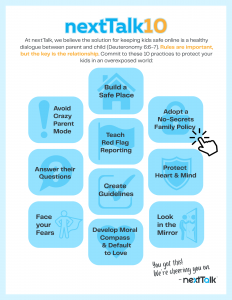
Welcome to the Next Talk Podcast. We are a nonprofit passionate about keeping kids safe online. We’re learning together how to navigate tech, culture, and faith with our kids. Protect your heart and mind. This is part of the Next Talk 10 core practices. As a reminder, these 10 principles are a way for you to create a culture in your home where you and your child can talk about anything. That is the solution that will keep your kids safe online and off. So today we’re tackling this practice of protect heart and mind. When my kids were little, I was able to protect their heart and mind. I had a lot of say in what they were watching, if or what they were playing on the family iPad, what kind of educational games and stuff like that. It was my job to protect their heart and mind when they were young. But then they started getting exposed to things. And it was before they had their own devices. So when I say exposed, what I mean is other kids would tell them things. And I realized right away that I had to make a shift. See, I was the one protecting their heart and mind. But I had to shift from protect to prepare. Prepare is the phase where you are preparing your child to protect their own heart and mind. You’re preparing them to be in this world and understand they’re going to be exposed to things, but they have to protect their heart and mind. They have to be an advocate for themselves. It is their duty, their body that they are responsible for that they have to protect their heart and mind. Early on, my kids were being exposed to things like graphic porn details that other kids were watching and then sharing with my kids. Or they were being told, go Google this kind of porn or this kind of sex by their friends, by people at school. When those kinds of things started happening with my children, I didn’t want my kids to think I can’t look at that, or my mom or dad will kill me. That’s not what I wanted my kids to think. I wanted my children to think, is this good for me? Is this good for my heart and mind? Would God want me to watch this? Right? Do you see the difference? Because early on it was kind of like the first response, old Mandy response of just, I just want them to be afraid of me. I had to push into this new way of thinking, new Mandy. And over here, me pushing them into this space of, is this good for me? It causes them to become an advocate for themselves. It’s actually teaching integrity, right? Like when I’m not there, when you are alone with a device or alone with a friend who’s trying to show you something on their on their device, you have a decision to make. So if we think of it like that, there’s a lot of education that we have to do to teach our kids about why it’s important to protect their heart and mind, why they need to be an advocate for themselves. And what I would say is look for teachable moments. When my son was very young, he went to school. This was before he had a device of his own, and he was told about a horror movie. And it was a killer clown movie. I don’t remember exactly the name of the movie. He came home and told me about it right away. And that was after we had implemented red flag reporting. Go watch that video. Because on there, anything mean, violent, bullying, or scary, um, you report to me. And so he had reported this horror movie to me that he had been told about at school. And, you know, we had a talk about it. And I said, Thank you so much for telling me. You know, these things are scary. It’s important to protect our heart and minds from this. Well, later on that week, in the middle of the night, I hear feet pitter-pattering towards my room, towards my bedroom, just darting, jumping in bed with me. He had had a nightmare about that movie. And I, you know, in the middle of the night, I just consult him. You’re right. I just want to make sure that he feels better. You’re safe. I reassure him it was a nightmare. But the next day on the way to school, I use that as a teachable moment because I thought to myself, at some point, he’s going to be faced with having to look at pornography. He had not been yet at that, at that point. And I thought to myself, I want him to really think about what he’s letting in his heart and mind when he has that option. And so on the way to school, I used the horror movie as a teachable moment, right? And I said, you know, when we let things into our heart and mind that aren’t good for us, it can make us lose sleep. It can make take our focus off of good things. And so I don’t want that for you. And the same thing goes for, you know, things you see on your computer or things you hear from your friends. And you have to protect that. So kind of role-play with them. Like, what are you going to do the next time a friend starts telling you something in graphic detail that you don’t think would be good for you? Just say, hey, I appreciate you wanting to share this information with me, but I’m good. I don’t need to know that, right? And you can be kind about it. You don’t have to be mean. You don’t have to shame the other kid because they’re just like sharing what they know. But you can also have boundaries for yourself. Like, I’m not going to let this in my heart and mind. We have a team member, and she she uses the analogy of opening a window. Like, what are you opening a window to and allowing into your life? And you, you have a duty to create boundaries around that. And you guys, as I was learning to teach my kids to protect their heart and mind, this didn’t just pop out of thin air. This was wisdom I got from the Bible. Proverbs 4.23 says, Guard your heart above all else, for it determines the course of your life. And we have to be careful with our heart because Jeremiah 17.9 warns us that the heart is deceitful above all things. In Matthew 15, 18, it says, things that come out of a person’s mouth come from the heart, and these defile them. What that’s saying is things we speak, things we do, our actions, our behavior, it all starts with like a thought in our brain that goes to our heart and that infiltrates our spirit. And then we act on it. So to protect our heart and mind is a life skill that our kids need. We’ve been talking about the heart on these verses. Let’s talk about the mind, what we allow in. I love Psalm 101.3. It says, I will refuse to look at anything vile and vulgar. I really, really like the New American Standard version of this. It says, I will set no worthless thing before my eyes. The Bible warns us over and over again that we are to protect our heart and mind. I know we’re talking about protecting our hearts from pornography, protecting our hearts from screens, protecting our hearts from scary things or mean things that our friends may be telling us about. All of those things are true, but also it’s protecting our heart and mind from our friendships, right? Like Proverbs 13, 20 says, walk with the wise and become wise. Associate with fools and get into trouble. Why is that? Because we’re associating with fools, we’re letting in their ideology, their thought process into our brain, and it’s seeping in into our heart and mind. And then that’s going to flow out into actions and behaviors. You know, at the beginning of this show, I talked about how I wanted to switch from my kid thinking, oh, mom will kill me if I look at this, to is this good for me? I want to talk about this a little bit more because I think Christian parents in particular, and I can speak to this because I’ve been in the Christian world for 20 years, I think we’ve been really bad about this. We just want our kids to like line up and not do things, right? Like just don’t look at that. It’s awful for you. We really have to get out of that mentality. You know, rules are important, but it’s about the relationship. The relationship you’re developing with your child, it’s also about the relationship that you’re teaching your child to develop with the Lord. We want our kids to have integrity so that when we’re not there and they’re in that moment, they will respond with, what would Jesus do? What would Jesus want for my life right now? Is this good for my heart and mind? As I was teaching this to my kids, one day one of my children got in the car after school and said, Mom, what does this mean? Highly sexualized question. Highly sexualized, okay? And they reported that to me because of the red flag reporting. Any new word, phrase, or idea you don’t know, you need to come home and ask me. My kid came home and asked me this highly sexualized question. I took a deep breath and I thought, here we go. They’re reporting to me. I’m not gonna be crazy parent mode. I’m gonna talk in calm, age-appropriate ways and explain this to my child. As I started to progress in explaining this, do you know what this child did? Held up their little hand in the car and said, Stop, mom. I want to protect my heart and mind from this. Because if you tell me this, I can already tell where this is going. I’m gonna be thinking about it at night. I’m gonna be thinking about it when I go to bed. I don’t want that. I don’t want that burden. And you guys, that was the day that I realized this works. My child had become an advocate for themselves and said, you know, I don’t, I don’t want to know all that yet. I’m not ready for all that. There will be a day when we can talk about that, but I don’t want that now. Instead of me just saying you’re not ready for that, I allowed my child to have a say in it. And that has gone so far into helping mature my kids and build our relationship. Another cool thing started to happen in our home. So we have an older sister and a younger brother. And I don’t know how old my daughter was. I can’t remember the ages, but one time we were watching the Super Bowl and a really inappropriate sexual ad came on for an upcoming show. And my oldest daughter, I just remember it like in slow motion, she lunged in front of my son and she said, Bubba, Bubba, protect your heart and mind. And you guys, it was so precious. And I tell you this because if you have older kids, you know, you may want to say to them, hey, when you hear new words and you want to ask me about them, don’t do that in front of your younger brother or sister because our duty is to protect their heart and mind. They’re not where you’re at, where you’re ready for that information. And so ask me privately. These older siblings that you will see them lead in your home. You will see them start to be protective of their younger siblings. And it is really cool to see that modeled in your home. Protect your heart and mind. It is our job to do that when our kids are little. But then we have to shift and we have to prepare them, teach them how to protect their own heart and mind. That will allow them to go out in the world and live in the broken world that we live in, but to protect themselves in a godly way. And just as the Bible instructs, we are to guard our heart and mind, and we are discipling that and teaching that to our kids. It’s part of the next top 10. Implement it in your home today.
SPEAKER_00:
Next Talk is a 501c3 nonprofit keeping kids safe online. To support our work, make a donation at next talk.org. Next talk resources are not intended to replace the advice of a trained healthcare or legal professional, or to diagnose, treat, or otherwise render expert advice regarding any type of medical, psychological, legal, financial, or other problem. You are advised to consult a qualified expert for your personal treatment plan.
Spanish
Transcript Not Available
This podcast is not intended to replace the advice of a trained healthcare or legal professional, or to diagnose, treat, or otherwise render expert advice regarding any type of medical, psychological, or legal problem. Listeners are advised to consult a qualified expert for treatment.
Subscribe now
Subscribe to our monthly newsletter for all the latest podcast titles, events, and nextTalk news.